Refugees and Immigrants in Greece: Creation of a Hellenism
Antonella Borjas
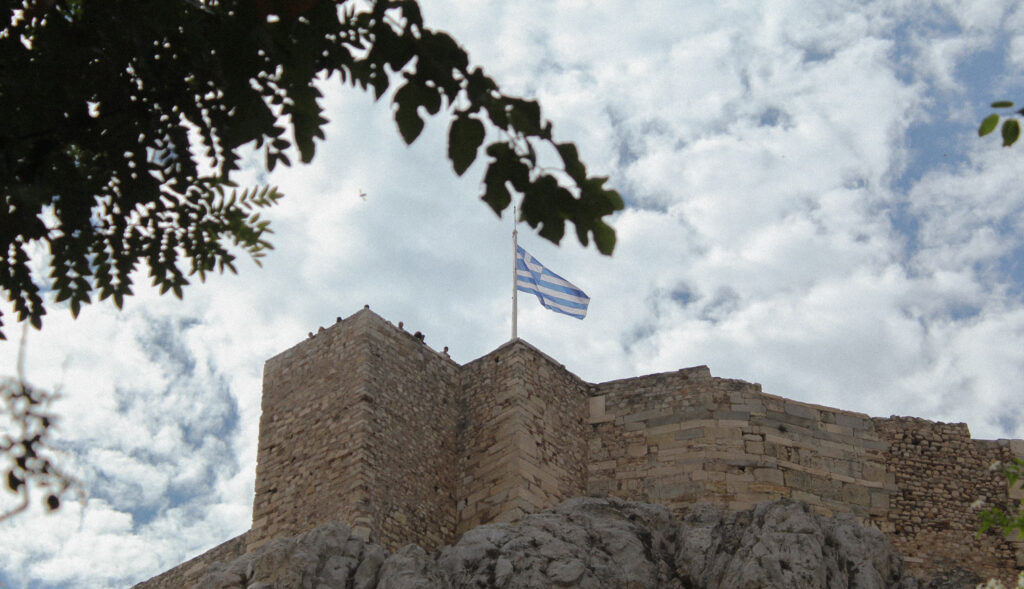
Greece is considered a cultural hotspot due to the impact it has had on an international level—with an emphasis on Western civilization (Katerina Zacharia 279). The history behind the immigration crisis in Greece has stemmed from three major events, the Greek Civil War in 1946 (Zacharia 324), the Turkish invasion of Cyprus which led to the division of Greco-Cypriot and Turko-Cypriot parts (Zacharia 330), the Greek financial crisis of 2008, and the fall of Greek borders in 1991 (Zacharia 243). These events caused for an influx in immigration which also leads to different views of immigration to emerge. One of the prominent sentiments that stems from the influx in immigrants and refugees is one of xenophobia, this can be seen in a survey conducted by DioNEOsis in which Greek citizens believe that immigrants should not be integrated into society and rather should be relocated to different countries as swiftly as possible (DioNEOsis 2024). In this essay I will show how the films in the Los Angeles Greek Film Festival of 2025 show how immigrants and refugees have impacted Greek society to such a large extent that their impact has become integral to Greek history. The feature films that will support this essay are Construction Workers, Our Heroic Comrades directed by Giannis Xydas (2024, 56 minutes), The Return That Never Was. Cyprus 1974-2024 directed by Athanasios Gioumoasis (2024, 88 minutes), A Couple of Years directed by Lydia Konsta (2024, 85 mins), along with a selection of feature films. This paper argues that immigrants and refugees create integral changes to Greek society that are initially critiqued but are later recognized as parts of Greek culture.
Immigration And Greece
To understand the immigration towards Greece one must understand the different reasons why people are forced out of their native countries or areas. After the Greek Civil War, the countryside was left devastated and an anticommunist mindset was encouraged, this left exiled and persecuted to be severely executed especially in the work field. This led to thousands of young people to immigrate towards the capital and seek work in construction (Xydas 00:00:31). It is important to note that the wave of persecuted and exiled peoples immigrating towards Greek capitals were also Greeks, the distinction being that many had certificates of social beliefs that were deemed against the state (Xydas 00:06:28). In a different way, culture was created by immigrants’ desire to return to their homes. Before the Turkish invasion, Cyprus had its own culture and served as a cultural hub with people from surrounding areas sought work (Gioumoasis 00:02:47). Throughout and after the invasions many citizens of Cyprus were forced out of their homes or opened their properties for refugees to stay in, as this occurred people were unable to sustain themselves economically which pushed them to immigrate to places with more economic opportunities (Gioumoasis 00:41:35).
The result of the invasion was the discrimination of Cypriots—specifically Greek Cypriots with the creation of enclaved lands in “free zones” of Cyprus. The creation of different identities in Cyprus creates different cultural identities that are often compared to Hellenisms, as seen in Skammata directed by Danae Stylianou (2024, 86 mins) in which the Athens Museum held many artifacts during the Turkish invasion (Stylianou 00:51:12). Events such as the one mentioned created a tie between Greek and Cypriot cultures. The financial crisis (2008-2018) combined with an influx of refugees was another reason for the rise in tension between Greeks and immigrants as the Greek government was not prepared to handle the situation properly (Philip-Edward Phillis 224). Though the Greek financial crisis is not reflected directly in the films of the Los Angeles Greek Film Festival, the tension post the crisis can be explored through the creation and rise in power of the Golden Dawn (Phillis 6). Lastly, one of the major migration movements and points of globalization is the fall of the borders in 1991. The fall of the borders created tension between Greeks and Albanians that is still present to this day, one way is with the creation of the narrative that Albanians are criminals and should be treated as such. This later became a system that pushed Albanian immigrants towards crime as it was the only perception they held (Phillis 49). The films mentioned in this paper will show how immigrants are perceived in Greek media and how the meaning is changing towards acknowledging immigrants and refugees as a part of Greek culture and identity.

The Greek Civil War: Construction Workers, Our Heroic Comrades and A Couple of Years
The Greek Civil War (1944-1949), and the overlap of World War II served as a catapult for the migration of peoples (Zacharia 324). The film Construction Workers, Our Heroic Comrades (Xydas, 2024) follows the story of post Greek civil war immigration, with a focus on construction workers. The immigration pattern shown in the film is of exiled and persecuted Greeks—mostly from rural areas, and their experiences as construction workers, or c-workers, in the capital of Greece. The interviewees are all exiled Greeks that sought to be c-workers since it was the only line of work that didn’t require a certificate of social belief (00:03:20). One way in which the c-workers were able to form a sense of community was they protected each other and respected the difference in beliefs they had. During a time that was defined by social beliefs creating a community devoted to protecting each other and mutual respect was no easy feat. One of the retired c-workers described it as having “…built solidarity among us, we became parts of a whole” (00:10:25). The depiction of the c-workers was also heavily defined by who held power as seen in Representation, “… in every epoch, ideas reflect the economic basis of society, and thus the ‘ruling ideas’ are those of the ruling class which governs a capitalist economy, and correspond to its dominant interests,” (Stuart Hall 32). The ruling ideas at the time were provided by the police or The General Confederation of Greek Worker, which was led by a right wing, anti-union leader Makris (00:16:52). With c-workers being portrayed as enemies of the state and anti-Greek then the narrative was pushed that they should be seen as lesser than Greeks.
Further, as the documentary progresses the c-workers begin to detail the impact their efforts to unionize had and how they became a defining advancement for Greek society. Those advancements were the seven-hour workday, insurance, and healthy working conditions (00:27:48). After the c-workers achieved their demands then they were no longer seen as nobodies but rather seen as revolutionaries that stood up against the powerful regime (00:50:10). This change in power and representation can be seen as a change in discourse given that c-workers went from being seen as nobodies and exiled members of society to celebrated and respected by Greeks for their work to better Greek society. This change in discourse can be described as a change in the perception of self in society and culture (Hall 28). Construction workers consisted of the least powerful as they were systematically persecuted, despite this they were able to become the reason for humane working conditions despite backgrounds. In other words, the film Construction Workers, Our Heroic Comrades documents the struggles of Greek immigrants and highlights their impact on Greek culture.

The second film that also shows Greek immigration as a result of the job market is the film A Couple of Years (Konsta, 2024). The film opens with a video of men working at a factory with narration that says, “The agreement that sent the first Greek workers to the North was signed in 1960 between the Kingdom of Greece and the Federal Republic of Germany and has the status of a treaty” (Konsta 00:00:09). They go on to describe how Greek immigrants were treated in Germany and how their stays were elongated to an excessive point, immigrants stayed in battered housing with little pay. One of the messages throughout the film is the lack of belonging that Greek immigrants felt in Germany having to accept two cultures as their own. In some ways the Greek government mistreated its people by forcing families to split in order to pursue work, this was explored in the story of Vasso and her family. Vasso describes her family leaving her when she was one year old in Greece and taking her to Germany with them after three years (00:19:20). On the opposite end of the spectrum there are the German immigrants entering Greece which is criticized by Greeks initially but changed after the civil war (00:27:16).
Similar to the message in A Couple of Years, the short film A 10-Minute Swim (Achilles Tsoutsis, 2024) shows how Albanians of Greek descent were not allowed to return to Greece and this caused for a mysticism to form surrounding Greece. The main protagonists risk their own and their families lives for the opportunity of a life that they had only heard of; this film can be used to understand the desire that Greeks had for community in Albania. In A 10-Minute Swim Greek Albanians are forced to denounce their Greek identity, A Couple Years mirrors this with Greek Germans pushing their identity away as a means of fitting into German culture better. Both films focus on immigration serving as a conduit for culture and unity, this is done by showing how German spaces housed Greek culture, showing a Greek teacher showing German students of Greece, and by detailing how a desire to return to Greece created a new identity within Germany (01:04:33). The creation of bridges across cultures in A Couple of Years (Konsta, 2024) is one way immigration caused for the creation of a new sense identity for both immigrants in Greece and those in Germany.
Greek directors refuse to deal with the Greek experience and use the mirror of the immigrant in order to depict the crisis of meaning, authority, and purpose that seems to dominate social life, without ever admitting that they themselves are the immigrants we see on screen, strangers in their own land.
Katerina Zacharia, Hellenisms P. 241
Search of identities in The Return That Never Was. Cyprus 1974-2024
Another point of immigration in and around Greece is that of Cypriots. During and after the 1974 Turkish invasion of Cyprus Cypriots were displaced due to economic and social collapse. The film The Return That Never Was. Cyprus 1974-2024 directed by Anthanasios Gioumpasis (2024, 88 minutes) the struggles of Cypriots living post the Turkish invasion is represented. The film begins by illustrating the culture that existed within Cyprus previous to the invasion, this is done by having people talk about what they found lively in their towns. One man describes Achna as a rich village that thrived with outsiders and describes how they had the first stadium which housed first division teams from surrounding areas (00:03:07). The film then follows the retellings of the war by Cypriots who experienced the invasion firsthand.
For this paper the section on Greek-Cypriots is the most relevant. Throughout the span of the war Greek-Cypriots were lost at war and countless remains were not found (00:47:17). This marked the start for Greek-Cypriots to begin their search for identity in a place where they are pushed away, this message is amplified by the stories of “Enclaved Greek-Cypriots” (00:51:56). One way in which the topic of enclaved Greek-Cypriots is approached is by describing that they are people that have been deprived of everything in their lives and now want to rebuild their communities and keep their culture alive (00:53:44). This message is mirrored in Between a Rock and a Hard Place directed by Thanos Liberopoulos (2024, 17 minutes), the kids of Afghanistan speak on their experiences living under Taliban rule and go as far as to advocate for those that remain in Afghanistan whilst in Refugee camps in Athens, Greece. One way of understanding this is that people long for the culture and backgrounds they know and being forcibly relocated causes for a gap to occur in terms of culture. The search for culture creates an identity in itself as it breaks the isolation immigrants feel in terms of their surroundings.

In both films death haunts the protagonists, the children in Between a Rock and a Hard Place (2024) are haunted by those that passed away on refugee boats and those in The Return That Never Was. Cyprus 1974-2024 (2024) is faced with the reality that they may not be able to bury their loved ones. In both instances a group of people is stripped of their culture and moved to a foreign land to which they are not given the proper tools to assimilate themselves with.
Conclusion
The films Construction Workers, Our Heroic Comrades directed by Giannis Xydas (2024, 56 minutes), Gioumoasis (2024, 88 minutes) and A Couple of Years directed by Lydia Konsta (2024, 85 mins) shows how immigrants in Greece have created fundamental changes to Greek culture despite the backlash that they have faced in the process. InThe Return That Never Was. Cyprus 1974-2024 directed by Athanasios Gioumoasis (2024, 88 minutes) and Between a Rock and a Hard Place directed by Thanos Liberopoulos (2024, 17 minutes), immigrants are shown longing their homes and their culture, in some ways these films end the binary thinking of hero and villain and places the immigrants and refugees as a person seeking belonging and culture. A similar concept is explained in Hellenisms, “Greek directors refuse to deal with the Greek experience and use the mirror of the immigrant in order to depict the crisis of meaning, authority, and purpose that seems to dominate social life, without ever admitting that they themselves are the immigrants we see on screen, strangers in their own land” (Zacharia 241). This quote goes in hand with the argument of dismantling the binary of the Greek versus the immigrant. The films of the Los Angeles Greek Film Festival 2025 show how Greeks are also the immigrant in their own land which should bring forth the concept of Xenia—accepting and respecting of outsiders.
Bibliography
Gioumoasis, Athanasios, director. The Return That Never Was. Cyprus 1974-2024. 2024. 88:00
Konsta, Lydia, director. A Couple of Years. 2024. 85:00
Tsoutsis, Achilles, director. A 10-Minute Swim. 2024. 24:00
Liberopoulos, Thanos, director. Between a rock and a hard place. 2024. 17:00
Phillis, Philip E. Greek Cinema and Migration, 1991-2016. Edinburgh University Press, 2020.
Stylianou, Danae, director. Skammata. 2024. 86:00
Xydas, Giannis, director. Construction Workers, Our Heroic Comrades. 2024. 56:00
Zacharia, Katerina. Hellenisms: Culture, Identity and Ethnicity from Antiquity to Modernity. Routledge, 2016.
Hλίας. “What Greeks Believe 2024.” Dianeosis, 5 Feb. 2025, www.dianeosis.org/en/2025/02/what-greeks-believe-2024/.